Vintage Telegrams: A Look Back at the Original Instant Message
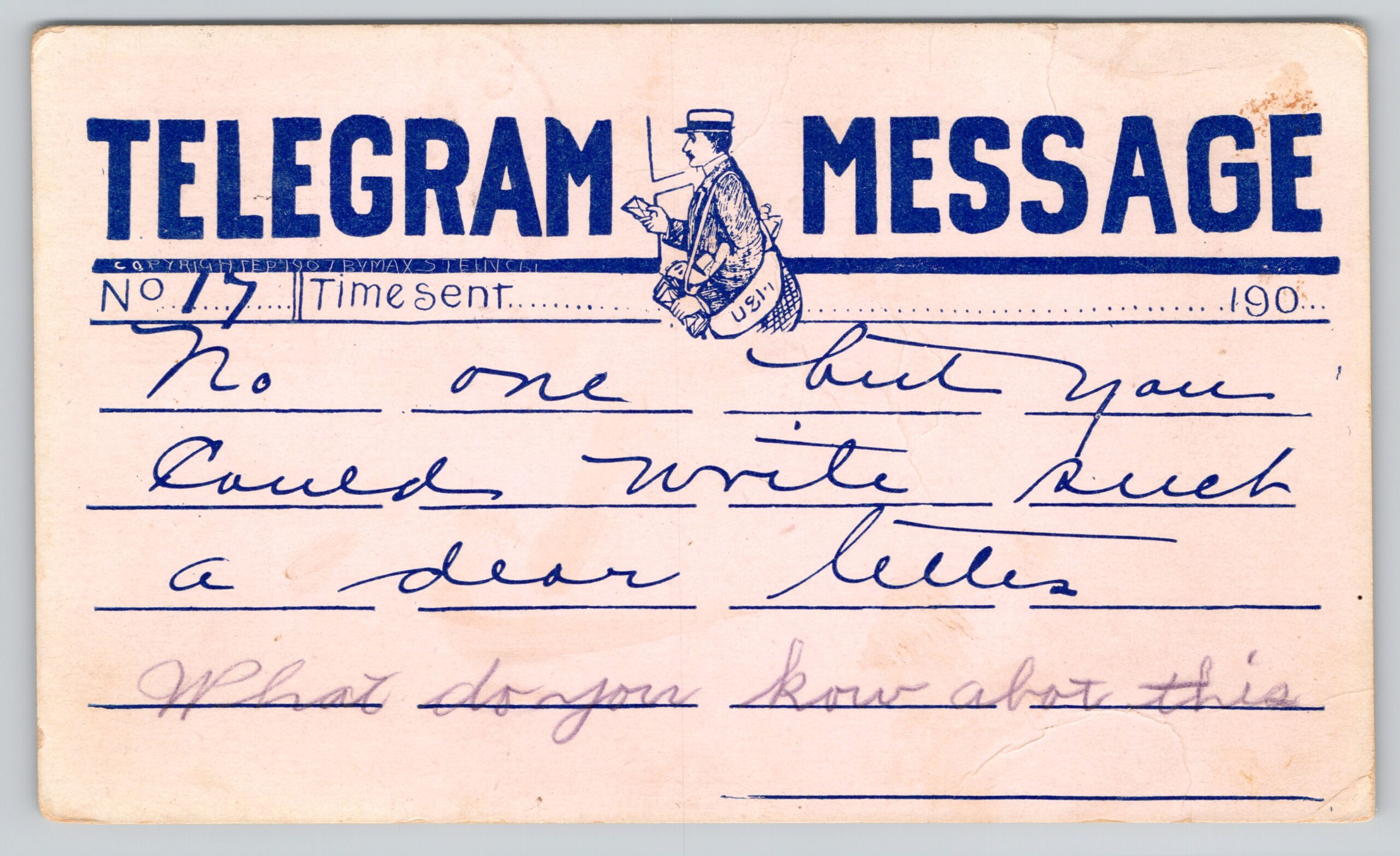
Before texts, emails, and even phone calls, there was the telegram — a short, urgent message delivered across great distances using the magic of electricity and Morse code. Today, vintage telegrams feel like charming relics from a slower but still impressively connected time. The included image was sent in 1908 and mailed as a postcard, not a traditional Telegram.
What Exactly Is a Telegram?
A telegram was a message sent via telegraph — an early form of electronic communication invented in the 1830s and widely used by the 1850s. The sender would go to a telegraph office, write their message on a form, and pay per word (which is why telegrams were famously brief and to the point). A telegraph operator would then transmit the message in Morse code to another office, where someone on the receiving end would decode it and deliver the printed message to its recipient, often by hand.
Think of it like an early, low-tech version of a text message — but instead of arriving on a phone, it came on a piece of paper, often sealed in an envelope with an official-looking stamp or logo.
When Were Telegrams Popular?
Telegrams started gaining steam in the mid-19th century, with Western Union sending its first transcontinental telegram in the U.S. in 1861. For more than a century, they were the fastest way to send written messages over long distances. By the early 1900s, telegrams were a part of daily life, used for everything from business deals to love notes.
They were especially common during times when quick communication was needed but long-distance phone calls were expensive or unreliable — like during wars, emergencies, and big life events. Telegrams were used up through the 1970s in many parts of the world, though their use started to decline sharply as telephones and, later, email took over. Western Union sent its last official telegram in 2006.
Why Were Telegrams So Brief (and Full of Capital Letters)?
Because you paid per word, most people kept telegrams short and sweet. To save money, people left out small words like “a” and “the,” and it became standard to write in all capital letters with little punctuation. Even the word “STOP” was used instead of a period — because the actual dot in Morse code (used for a period) cost extra, while “STOP” did not. So a message might read:
ARRIVING TUESDAY STOP BRINGING CAKE STOP CAN’T WAIT TO SEE YOU STOP
It might look a little robotic today, but back then it was normal, and even sentimental.
A Telegram Meant Something Important
Getting a telegram was serious business. Because they were used for urgent communication, people often assumed something big had happened — good or bad. During wartime, telegrams might bring news from soldiers or, tragically, notifications of a loved one’s death. But telegrams also carried joyful messages: wedding announcements, birth notices, job offers, and even heartfelt apologies.
Some people even sent telegrams just for fun — a quick “thinking of you” or “congrats” in a time when mail took days or weeks.
Collecting Vintage Telegrams Today
Today, vintage telegrams are prized by collectors, history buffs, and design lovers. They offer a glimpse into everyday life from decades past, often with gorgeous typography, company logos, or elegant forms that make them little works of art. Some are humorous, others touching or dramatic — a paper snapshot of someone’s moment in time.
Final Words
Though telegrams are long gone as a practical tool, they left a mark on how we think about fast communication. They were the first taste of instant messaging, and they taught us how to say a lot with just a few words. In an age of emojis and read receipts, there’s something refreshingly sincere — and oddly dramatic — about a sentence that ends with STOP.